
STORIES OF RESILIENCE IN TIMES OF CRISIS – June 29, 2025, 5-7 pm
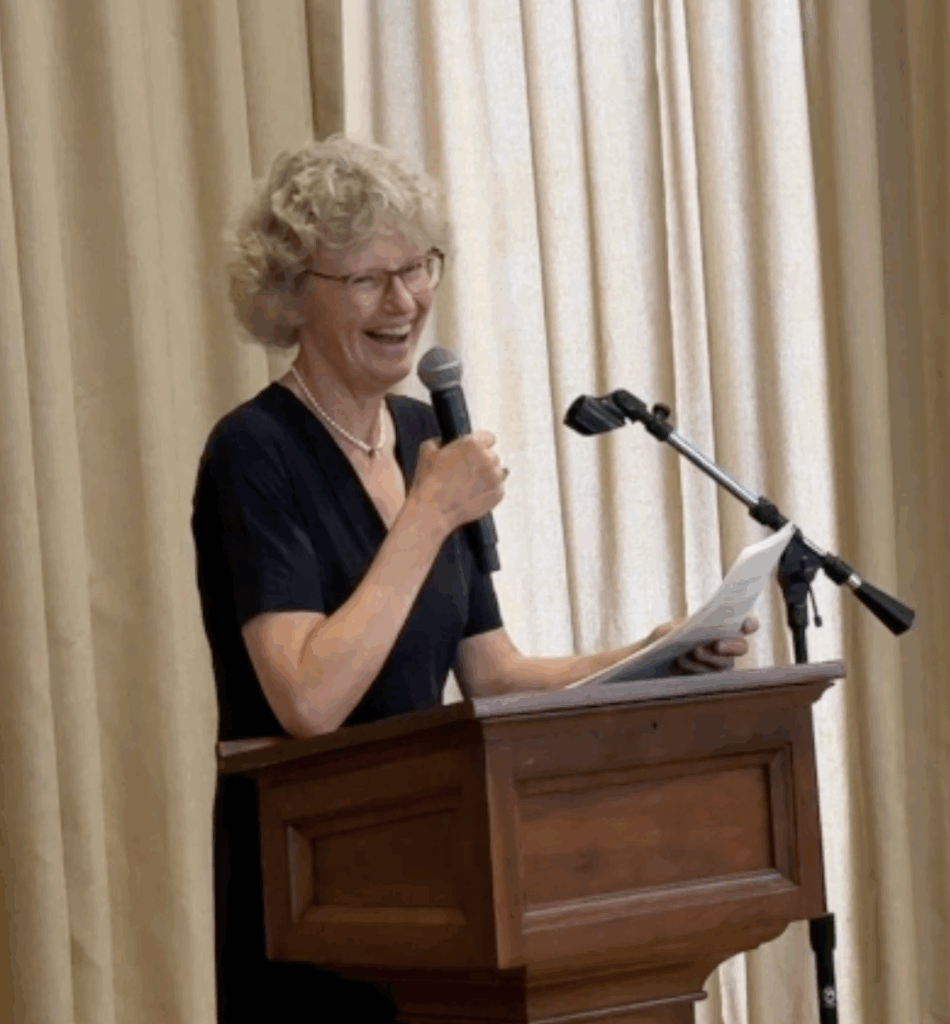
Liesbeth Heenk of Amsterdam Publishers introducing one of her authors.
It was a bright spring day in April 2015. I was pushing Manny Steinberg, then 90 years old, in his wheelchair across the gravel paths of Dachau. The beige stones crunched beneath the wheels. Manny, a Holocaust survivor and the author of the second survivor memoir I had ever published, had returned to Germany for the first time since the war. He had been invited by the German government to attend a commemoration at one of his former camps, Vaihingen an der Enz, and decided also to visit Dachau.
Manny was joined by his son, a daughter, and a grandson. As I pushed the wheelchair, I watched him closely. The longer we stayed at the camp site, the more withdrawn he became; he barely spoke. It was the smell of the soil, Manny later told me; it hadn’t changed in seventy years. That smell alone had the power to pull him back to his years in the camps.
On that day in Dachau, pushing Manny across the grounds he had once walked as a prisoner and listening to his stories, I understood the full impact a Holocaust testimony could have. It can help to heel deep wounds. The impact of these stories is profound. For many survivors it is the first time their voices are truly heard.
So on that day, I made myself a promise: If I can make this work financially, this is what I will dedicate my life to.
When Manny died, a few months after our visit to Dachau, a copy of his memoirs was buried with him.
More than a decade has passed. I’ve now published over 100 Holocaust stories – not scholarly works, but true accounts written by survivors, their children, and their grandchildren, alongside a few carefully chosen novels. This is just a beginning. I’ve said it before: my mission will not be complete until all six million stories are told.
I consider myself fortunate to receive manuscripts in English from all over the world. Although I’m based in the Netherlands, I don’t focus on Dutch authors or the Dutch market. As a matter of fact, I have none, and hardly sell a single copy in Holland. Of all the manuscripts submitted for publication, I accept only a select few, always aiming to maintain a high level of quality. On average, I publish between 15 and 20 books each year.
We are in a dark place now. What we are seeing today is not new. It’s the oldest hatred – repackaged, disguised, and brought into the mainstream. In today’s polarized climate, antisemitism thrives, often cloaked in the language of social justice or political critique. It feeds on misinformation and ignorance. More than ever, Holocaust stories matter. They remind us, starkly, of where antisemitism can lead.
As the Irish statesman Conor Cruise O’Brien once wrote, “Antisemitism is a light sleeper.” It awakens when society falters. And it spreads – quickly. The widespread lack of historical awareness only makes it worse.
One might think the situation in the United States is alarming – and it is. But the reality in the Netherlands is not much better. Antisemitic incidents there are disturbingly high. Israeli flags can be burned, Maccabi football fans harassed, and Jewish citizens openly threatened – often in the name of justice – all with little to no consequence. Israel is routinely demonized, and by extension, so are Jews. Politicians remain silent, afraid to offend. Across the political spectrum, antisemitism has become increasingly normalized.
For a time, we had a centre-right government headed by Geert Wilders, who is openly pro-Israel. But he was effectively powerless, as much of the Dutch civil service – traditionally very left-wing – was able to obstruct his proposals. There is a persistent lack of decision-making across government, law enforcement, and public institutions, all in the name of political correctness, which has become something of a national mantra.
In my view, the real danger in the Netherlands now comes from the left, which has been gradually overtaken by Islamist influence. Just last weekend, members of the country’s largest socialist party voted to halt support for the Iron Dome defense system. This same party PvdA/Green Left – is likely to be part of the next governing coalition following the upcoming autumn elections. Let us hope the war will be over by then and all hostages freed.
And rather than changing gear, I’m committed to publishing as many books in the genre as I possibly can. In July, I will be publishing no fewer than four new titles in this genre. My resolve is only strengthening.
Holocaust memoirs and true stories are not just about suffering. They are about resilience, resourcefulness, and an astonishing capacity for hope. These are powerful accounts of survival, struggle, strength, and the choice to embrace life. Each time I read them, I am struck anew by the courage and optimism of the survivors.
Each of us has different tools to combat antisemitism. Some work in politics, some in education, libraries, or the media. Others create through art and writing. My authors are among those who use their voices – presenting their books in schools, universities, and bookshops. They are my heroes. I’m deeply grateful to them. Many have become close friends.
Several of them joined me yesterday and today at ALA: Nechama Birnbaum, Oren Schneider, Roslyn Bernstein, Evelyn Joseph Grossman, Robin Black, Peter Wiesner, and Max Friedman. They’ve helped introduce our books to thousands of American librarians. Librarians are key to preserving history – any history – and like publishers, they are custodians of memory. In times when books are banned and librarians held personally accountable for what’s on their shelves, their perseverance is nothing short of courageous. Many have even signed up for our newsletter.
Whenever it feels like shouting into the void, I remind myself: a whisper of truth can travel further than a scream of hate – especially when it is echoed by many voices. But the problem is, most people don’t echo. I sometimes hear, “Liesbeth, you’re doing such important work.” And when I ask, “How would you know?” it turns out they follow me – but never like or share a post… I understand; I also don’t share everything I agree with, to keep Amsterdam Publishers out of political debates.
It’s the deafening silence of the majority that troubles me most. That kind of silence isn’t neutral. It’s enabling.
In 1930s Germany, it was the silent masses who turned a blind eye. And today, once again, the answer may lie with the silent majority: those who perhaps care but don’t know how to help, or don’t realise the consequences of inaction. They can no longer afford to stay quiet. Western civilisation is being dismantled from within – not with weapons, but with slogans. If we want to preserve our democratic ideals, we must act. Each of us must do what is within our power.
There is also an essential role for non-Jews. As many of you know, I’m not Jewish or Christian – I’m agnostic. The Jewish people cannot and should not be expected to fight this fight alone.
We must all find our voices in speaking out against Jew-hatred. For non-Jews, speaking up against institutional silence and complicity is not only safer – it’s necessary.
There are many excellent educational programs about antisemitism and Holocaust history. But what doesn’t yet exist is a foundation that spreads free Holocaust stories in book form. And I believe deeply in the power of storytelling. Stories can move hearts, foster empathy, and resonate across cultures.
At our Amsterdam Publishers Authors event in New York last September, I announced the launch of a new nonprofit: the Survivor Stories Fund. I’m happy to report that it is now officially established. The board is currently pursuing charity status and plans to register in the United States, ideally under the umbrella of the Netherlands America Foundation. These processes take time, but within six months, we hope to be operational.
Once launched, the Fund will allow people to donate Holocaust books to schools, libraries, universities, museums, and educational events. Schools are crucial. If we want to push back against propaganda and denial, we must flood the world with truth. Quietly and steadily. Books rather than banners. Testimonies, not TikToks.
You might wonder: what does the daily life of a Holocaust publisher look like?
My mornings start on a glorious note. I drink coffee from a hilarious mug by the Breakfast Republic. It has three markings on the outside:
- “Unable to communicate in full sentences.”
- “Slightly more coherent but still unable to hold a conversation.”
- “You may speak now.”
I love it! Every day I start with a huge smile and start checking my emails. I rarely talk to anyone before noon – most people I work with are based in the US. I receive too many emails, and most emails are far too long for someone as impatient as I am.
Last year, I had three publishing assistants. This year I do everything alone again. Oddly enough, I’ll publish 23 books this year – nearly double last year’s total of 13, including German translations.
My days are fairly uneventful. I deal with Amazon and IngramSpark system issues, covers not showing, books arriving late, communicate with editors and cover designers. I input metadata, set up ads, update websites, purchase ISBNs, correct galleys, manage cover tweaks, review work done by interns, send newsletters, and correspond with libraries. I read new submissions – that’s the exciting part – and sometimes I have to close submissions because the pipeline of manuscripts is full. Around 2 pm I usually have my first Zoom with an author. There’s little time left for creative thinking. The only time I find space to reflect is while travelling – usually for work. And that’s what I love most.
My current life couldn’t be more different from when I worked at Christie’s in London or at Sotheby’s in Amsterdam. I used to travel through Scandinavia to view a Picasso in some wooden cabin, and value works of art in a palazzo in Padua, or the inventory of a modern art gallery in in Jerusalem, enjoying endless cocktail parties with wealthy clients. I was quite good at cocktail parties..!
Now, my life is totally diferent but much more fulfilling.
Since October 7, I’ve felt an even greater sense of urgency. Publishing is one way I contribute, but there’s more I feel compelled to do. And I do that after office hours. I try to avoid becoming political in my profession as publisher, I reserve that for my free time.
I am truly blessed with my group of authors. Many have become friends. Whether we meet on Zoom or in person, it’s always meaningful.
When Peter Wiesner organized this event, I had no idea I would be the main speaker. I’m grateful to all the organizers at: Rodeph Shalom (Jeff Strauss), Tikvah (Abby Gilbert), Hamec (Fabulous Flores), Prism Outreach (Heshie Zinman), and David Lee Preston of Sons and Daughters of Holocaust Survivors.
I am humbled by this attention, and hope that my work – and that of my authors – makes a small difference. If this attention helps bring more readers to these books, then I’m happy.